
Balancing Beads vs. Wheel Weights: Which Works Better for Truck Tires?
Balancing Beads vs. Wheel Weights: Which Works Better for Truck Tires?
Search balance beads vs. wheel weights, and you will find arguments for both sides. Some truck owners prefer balancing beads because they redistribute inside the tire as it rotates, while others rely on wheel weights for a measured correction. But when it comes to truck tires, which method offers the better balance of performance, maintenance, and cost?
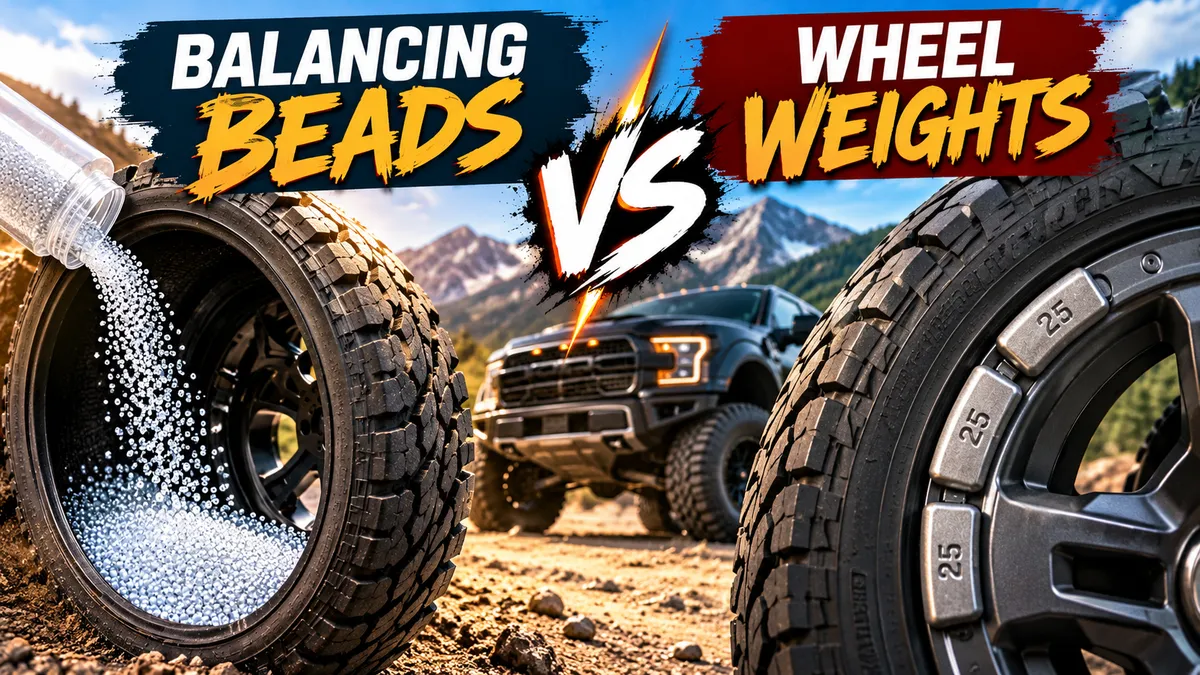
It will depend on the specifics of your truck, tire size, driving conditions, and maintenance needs. Balancing beads work inside the tire, while wheel weights attach to the rim at specific points to correct uneven weight distribution. Both methods can help reduce vibration when properly selected and installed.
Cost is another factor worth considering. According to the American Transportation Research Institute's July 2026 report, average trucking tire costs increased by 6.4% in 2025, reaching $0.05 per mile. Understanding how balancing methods differ can help operators make informed tire maintenance decisions and manage ongoing costs.
How Do Balancing Beads Work?
Balancing beads are small particles, often made from glass or ceramic, that sit inside the tire. When the wheel rotates, the beads move along the inner surface and redistribute in response to rotational forces, helping counteract uneven weight distribution and reduce vibration.
Beads are not fixed to one point on the rim like wheel weights. They can redistribute as the tire rotates, making them an option for some long-haul and heavy-duty truck applications.
Advantages of Balancing Beads
Internal balancing: By having beads inside the tire, eliminating external wheel weights.
Reduced risk of weight loss: There are no rim-mounted weights to loosen or fall off.
Adaptability: The beads can redistribute as the tire rotates and its wear pattern changes.
Heavy-duty applications: They may suit certain truck tires when the setup is compatible.
What Are the Drawbacks?
Balancing beads need to be measured in correct quantity and proper installation. Depending on the product, moisture may cause clumping, while incompatible materials or incorrect installation may create valve-related problems. Not every tire shop supports this method, so check tire compatibility, manufacturer recommendations, and service availability before choosing it.
How Do Wheel Weights Work?
Wheel weights are small metal pieces attached to the rim to correct measured imbalances in the tire-and-wheel assembly. A technician mounts the assembly on a balancing machine, measures the imbalance, and places the required weights at specific positions.
The correction remains fixed until a weight is removed, lost, or the assembly's balance changes.
Advantages of Wheel Weights
Measurable correction: A balancing machine identifies where weight is needed and how much to add.
Straightforward servicing: Technicians can remove, reposition, or replace weights during tire maintenance.
Wide availability: Most conventional tire shops offer wheel balancing.
Predictable installation: The technician can verify the correction on the machine before reinstalling the wheel.
What Are the Drawbacks?
Wheel weights can loosen, corrode, or fall off, requiring rebalancing. Their environmental impact is also a concern, as the Ecology Center estimates that 64 million kg of lead is used worldwide each year to manufacture wheel weights. Unlike balancing beads, wheel weights stay fixed in place and do not adjust as tire wear changes.
Balancing Beads vs. Wheel Weights: Main Differences
Feature | Balancing Beads | Wheel Weights |
|---|---|---|
Location | Inside the tire | Attached to the rim |
Correction | Redistribute during rotation | Fixed, measured correction |
Installation | Added inside the tire using an approved method | Positioned using a balancing machine |
Maintenance | Depends on tire servicing and compatibility | Easy to inspect and adjust |
Initial cost | Varies by product and labor | Often economical for routine balancing |
Availability | Depends on the tire shop | Widely available |
Main consideration | Correct quantity and compatibility | Accurate measurement and secure placement |
Neither method guarantees longer tire life or better fuel economy on its own. Tire pressure, alignment, load distribution, driving habits, and regular inspections also affect tire performance.
Balancing Beads vs. Wheel Weights: Which Is Best for Truck Tires?
Tire balancing beads and weights both correct uneven weight distribution, but they work differently. While wheel weights attach to the rim, balancing beads move inside the tire as it rotates. The following factors can help you decide which option is more appropriate for your truck.
How Each Balancing Method Works
Wheel weights are installed after a balancing machine identifies the location and amount of imbalance. A technician then attaches the appropriate weights to the rim as needed and confirms whether the balancing has been done properly. This process is part of professional tire balancing services, and adjustments can be made if the balance changes.
Balancing beads are placed inside the tire during installation or through that the product manufacturer approves. As the tire rotates, the beads move inside it to help counteract imbalance. Their effectiveness depends on the correct quantity, installation method, and compatibility with the tire.
Balancing Performance: Which Offers More Control?
Wheel weights give the technician a way to measure an unbalance using a balancing machine. The results can be checked before the truck returns to service, making this a predictable option for many truck tires.
Balancing beads work differently because they move inside the tire rather than providing a fixed correction. They may help address changing imbalance as the tire wears, but performance varies by application. Neither method can resolve every cause of vibration, such as damaged tires, bent wheels, or worn suspension components.
Installation and Maintenance Requirements
Wheel weights require the tire-and-wheel assembly to be checked on a balancing machine. After that, technicians place the required weights on the wheel and check for the correction. During maintenance, loose, corroded, or missing weights may need to be replaced.
Balancing beads demand the correct quantity and an installation method suited to the tire and product. Depending on the product, they may be added during tire mounting or through an approved valve-stem procedure. Proper installation helps avoid balancing issues, such as the symptoms of unbalanced tires. Regular inspections can also help identify problems early and maintain a smoother ride.
Performance on Long-Haul and Heavy-Duty Trucks
Long-haul trucks cover many miles, making reliable tire maintenance essential. Balancing beads seem to be a good solution for some heavy-duty tire applications because they move inside the tire as it rotates. However, compatibility with the tire, wheel, and operating conditions should be confirmed before use.
For commercial trucks, wheel weights might be more suitable because technicians can measure and correct imbalance during scheduled maintenance. The right method depends on the truck's tire specifications, fleet maintenance practices, and access to suitable service facilities.
Suitability for Rough Roads and Heavy Loads
Trucks working at construction sites, gravel roads, and uneven surfaces face greater exposure to impacts that can affect tires and wheels. Since balancing beads are inside the tire they cannot fall off the rim like external wheel weights. However, they cannot prevent impact damage or correct a bent wheel.
Wheel weights can also work in demanding conditions when properly installed, although strong impacts may dislodge them. For either method, correct tire pressure, appropriate load limits, and regular inspections remain important.
Cost and Long-Term Value
Wheel weights are widely used for routine truck tire balancing, and their cost varies according to size of the wheel, the number of balances, and labor. Additional service may be needed if weights become loose or the assembly develops an imbalance.
The cost of balancing beads depends on different factors such as material and manner of installation besides tire size and application. Therefore, before deciding on the right option, consider product compatibility, installation requirements, and how the tires will be serviced later. Neither method guarantees fuel savings or longer tire life, so the best value depends on the truck's actual operating needs.
Choosing the Right Balancing Method for Truck Tires
Choosing between balancing beads and wheel weights depends on your truck's tire specifications, operating conditions, and maintenance requirements. Wheel weights provide a measured correction that technicians can verify, making them a practical choice for routine truck tire balancing.
Balancing beads might be a good match for certain heavy-duty applications when approved for the tire and wheel setup. Before choosing either method, consider installation requirements, service availability, and long-term costs.
For assistance with your truck tires, CC Professional Tire offers quality tire products and professional services to support reliable performance and a smoother ride.
FAQs
1. Are balancing beads better than wheel weights for semi-trucks?
Not necessarily at all times. Balancing beads may suit certain heavy-duty applications, while wheel weights provide a measured correction that technicians can verify. Tire compatibility and operating conditions should guide the choice.
2. Do balancing beads improve truck fuel economy?
They may improve fuel economy in some applications, but results vary. Do not assume that a particular percentage of fuel savings will apply to every truck.
3. Can balancing beads cause tire vibrations?
Incorrect quantities, clumping, or unsuitable installation can lead to performance problems. Persistent vibration should be investigated by a qualified technician.
4. Do wheel weights fall off truck tires?
They can loosen or detach because of impacts, corrosion, or improper installation. Regular wheel inspections help identify missing or damaged weights.
5. Can balancing beads be used in every truck tire?
No. Compatibility depends on the tire, wheel, valve system, product, and manufacturer recommendations.
6. How do I know if my truck tires need balancing?
Steering-wheel vibration, cab shaking, and uneven tire wear can indicate an imbalance. Have a trusted repair shop inspect your truck to confirm the cause and rule out other mechanical problems.